Bees Are Speaking Through the Wax. Here Is What They Are Saying | The Bee's World 3
Inside the vibrational language that runs through honeycomb, and the research that revealed a communication channel we barely knew existed.

The Dance Has Another Layer
The waggle dance is the most famous piece of bee communication and for good reason. It is extraordinary. But it has drawn almost all public attention to one channel while a parallel communication system operates in a frequency most accounts entirely miss.
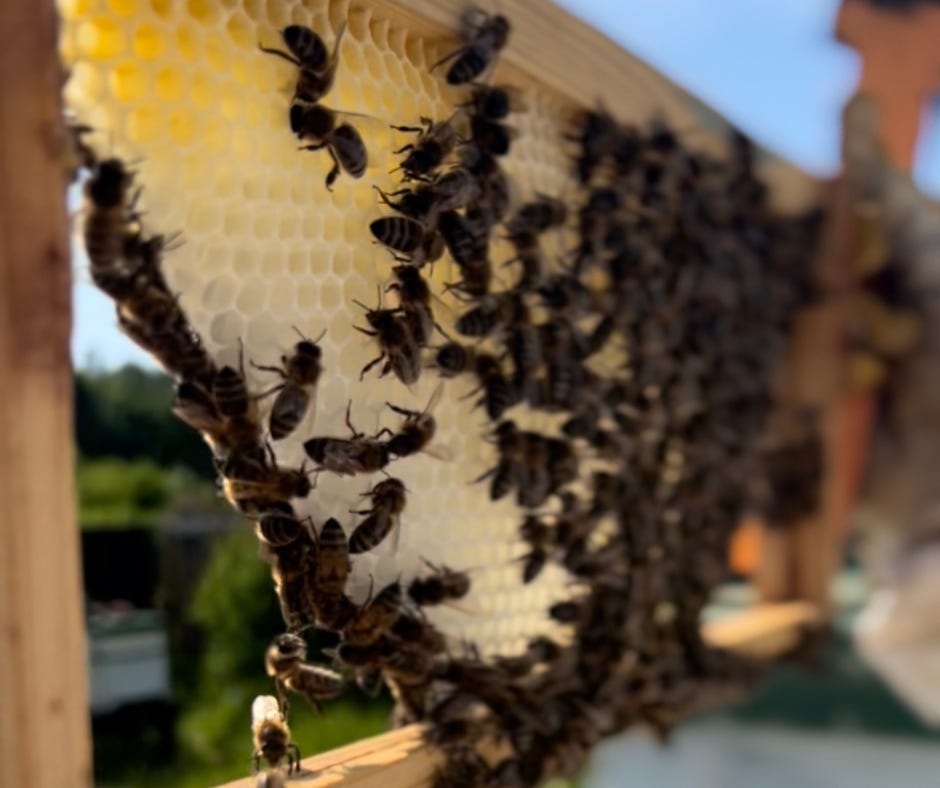
Bees communicate through vibration. Not through the air, in the way sound typically travels, but through surfaces. Through the comb. With their bodies pressed against the wax, running their flight muscles without opening their wings, transmitting information through the substrate itself. And the colony listens through their feet.
This is not a small supplementary channel. It is a primary one, running continuously through the physical structure of the hive.
If you want to keep following this series on how bees communicate through vibration, you can subscribe to receive the next essays as they are published.
The Waggle Dance Is Also Vibration
The waggle dance has a visual component. But the beehive is dark inside. A returning forager dancing inside the nest is not clearly visible to the bees surrounding her. So something else is carrying the information.
Follower bees maintain antennal contact with a dancing bee throughout the waggle run. What they are detecting through this contact is partly chemical and partly vibrational. The dancer produces a substrate vibration signal during the waggle run, transmitted through the comb surface, that follower bees detect through the sensory organs in their feet.
Remove the vibrational component, in controlled experiments and the accuracy of information transfer degrades. The dance does not have one channel. It has at least three running simultaneously. The vibrational channel is the one that makes it work in the dark.
I write science-led essays on bee communication, sensory systems and the hidden signals inside natural structures like wax comb. Subscribe if you want more like this.
The Stop Signal
Workers can interrupt a waggle dancer mid-dance. They approach thw dancer bee, press their heads against her thorax and produce a brief, high-amplitude vibrational pulse. The dancer stops. The recruitment message she was broadcasting is interrupted.
This is called the stop signal. It was first clearly described in the 1990s and has been studied with increasing precision since. Its function is not fully resolved, but current evidence points toward its role as an inhibitory signal in the colony’s collective decision-making: a mechanism by which experienced foragers who have encountered danger at a particular food source can actively counteract the positive recruitment signal coming from bees that have not.
One bee dances toward a food source. Another, who was attacked while foraging there by a predator or competing insect colony, stop-signals her. The recruitment and the inhibition run simultaneously and the balance between them influences how many bees ultimately fly in that direction.
The hive is not simply amplifying positive signals. It has a negative feedback mechanism built into the same system. That is a more sophisticated information architecture than a simple waggle dance description suggests.
Queen Piping and Tooting
Virgin queens produce two distinct vibrational signals that play a central role in one of the hive’s most critical transitions: the moment when a new queen emerges.
Piping is produced by an emerged virgin queen. It is a high-pitched, pulsed signal produced by pressing the thorax against the comb and running the flight muscles. Workers in the vicinity of a piping queen freeze in place, pressing themselves flat against the comb surface. This may protect them from being stung by a newly emerged queen that has not yet been accepted by the colony, and it prevents them from inadvertently releasing the remaining capped queens before the virgin queen is ready to deal with them.
Tooting is produced by queens still inside their cells, in response to piping. It is a slower, lower signal that announces their presence to the emerged queen through the walls of wax.
The exchange between a piping queen and tooting capped queens is a negotiation happening through the wax, audible to anyone who knows what to listen for. Experienced beekeepers can learn to hear both.
Bees & Beyond publishes this series for paid subscribers. Join to receive all four essays as they come out.
The Dorsoventral Abdominal Vibration
Workers produce a signal called the dorsoventral abdominal vibration, or DVAV, by pressing their thorax against the comb surface and vibrating without extending their wings. It can be directed at other bees, including the queen, or at the comb surface itself.
Its function appears to be contextual: used to stimulate the queen to increase her laying rate, to signal alarm in some situations, and as a general arousal or activation signal within the colony. The same physical signal appears to carry different meanings depending on the circumstances in which it is produced, which implies a degree of contextual sensitivity in the receiving bees that goes beyond simple stimulus-response.
In the second half of this essay, we look at how bees detect vibrations through their legs, why the honeycomb itself functions as a communication network, how modern hive design may alter the transmission of these signals and why researchers believe we have only identified a fraction of the bees’ vibrational vocabulary.
