Did the Trees Know the Eclipse Was Coming?
Three spruce trees, fourteen hours and what the science says about bees.


A Bees & Beyond Eclipse Special
I am Tita, a beekeeper and international bee science communicator based in Scotland and this is Bees & Beyond, where I write about bees, their biology, behaviour and the rather extraordinary ways they experience the world.
This is a little special edition for the solar eclipse. I wanted to know whether honey bees can sense an eclipse coming and what the science can actually tell us about it. In the process, I found 3 spruce trees, a very strange 14-hour signal and a scientific argument about whether anyone has any idea what was really going on. So, naturally, I went looking for the bees.
I inspected my hives on 11 August, the day before the eclipse, before I had even thought about the eclipse. Only afterwards did the thought arrive, soft and unscientific: the trees know tomorrow is going to be strange. I bet the bees do too.
I sat down to fact-check my own throwaway line and did not expect it to survive contact with the literature. It did. Half of it, anyway. And the half that survived is stranger than the sentimental version I started with.
All the studies I used for this piece are listed in the end of the article, so you can follow the rabbit hole yourself.
The forest that started preparing fourteen hours early
In October 2022, a team of researchers working in the Dolomite mountains of Italy had electrodes wired into a stand of Norway spruce, monitoring what plant scientists call the electrome, the constant low-level electrical activity running through a tree’s trunk as charged particles move through its vascular tissue. They were not planning to study an eclipse. A partial solar eclipse simply happened to cross the site while their sensors were running and they left the equipment on.
What came back was an inredible story!
Individual trees’ electrical signals became measurably more synchronised with each other starting roughly fourteen hours before the eclipse even began, building steadily through the night and into the following day, well before the eclipse’s direct reduction in sunlight reached the site.
The two oldest trees in the study, both around seventy years old, showed the strongest and earliest response, with the younger tree’s activity appearing to follow theirs rather than lead.
The researchers even wired up several storm-felled stumps nearby, out of curiosity and found a fainter version of the same synchronisation, evidence the stumps were still biologically active. The published paper describes the forest, at the peak of the effect, as behaving like an orchestra of phase-correlated plants.
I want to be honest about the scale of this before I get carried away, because getting carried away is exactly the trap this kind of finding sets. This is three living trees, plus some stumps, at one site, during one partial eclipse. It is published in a real, peer-reviewed journal, Royal Society Open Science, not a press release dressed up as a paper. But a sample of three is a sample of three and nobody has repeated this at a second forest yet. Treat it as a genuinely startling first result, not as settled fact about how all trees everywhere behave.
My favourite part: The original authors floated an explanation drawing on quantum field theory, proposing the synchrony might reflect something called a ‘macroscopic quantum coherent state’ and speculated it could even represent a kind of long-term ecological memory tied to the eclipse’s recurring astronomical cycle.
Another researcher published a formal response in the same journal, months later, arguing that the quantum explanation reaches much further than the evidence currently allows. Ordinary plant biology (things like shared root-zone signalling, changes in soil moisture and barometric pressure, or synchronised responses to a shared microclimate) could plausibly explain the same pattern without needing quantum theory at all.
That is what good science looks like from the inside. Not a single dramatic headline, but two serious people arguing about which explanation actually earns its keep. Nobody has settled it yet. I am not going to pretend either side has won.
So: did the trees know. No one can tell us that yet. What the researchers actually observed was a change in the relationship between the trees’ electrical signals before the eclipse and we do not yet know what produced it. That is a real, if young and unreplicated, area of active science. Which made me want, quite badly, for the bees to do something similar.
Here is where I had to let that hope go.
Enjoying the rabbit hole?
There are considerably more of these. Subscribe to Bees & Beyond for the next one.
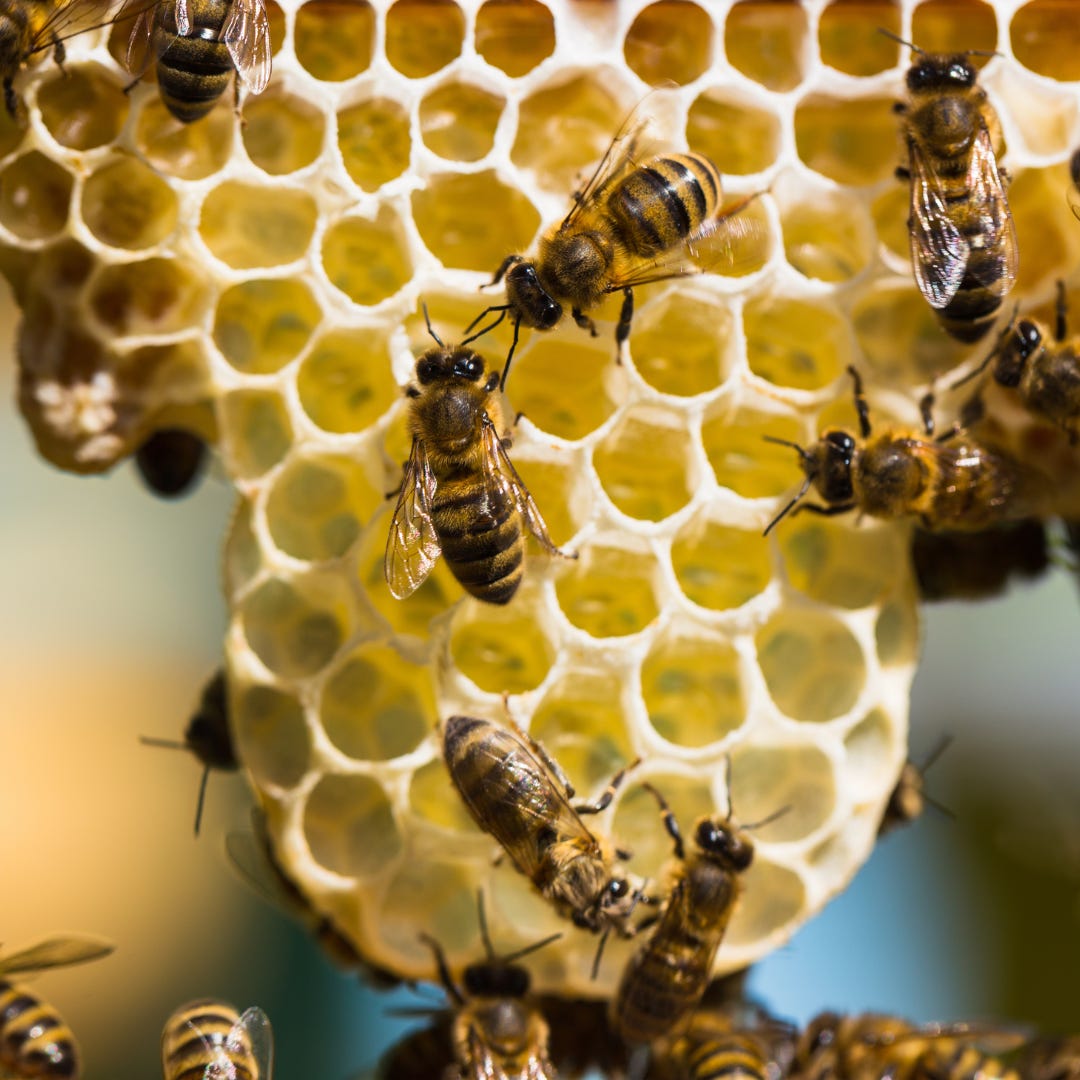
No honey bee study has ever found anything like it
The best-studied honey bee eclipses tell a fairly consistent story and it is a story about the present tense, not the future one.
During the total solar eclipse that crossed the United States in 2017, a team led by ecologist Candace Galen placed acoustic monitors near flowers at sixteen sites, from the Pacific coast to the Midwest. And simply listened for the sound of bee wingbeats through the entire eclipse event. Bees kept flying, undisturbed, through the partial phases both before and after totality, with no measurable drop caused by the dimming light alone.
Then, for the two and a half minutes of true darkness at totality, flight essentially stopped.
Across all sixteen sites, researchers recorded a single buzz during the entire period of totality. One. When light returned, so did the bees, immediately, with flight durations if anything slightly longer than on an ordinary sunny day.
Nothing in that data shows a bee doing anything before the light actually changed. A separate team monitoring ten full honey bee colonies during the same 2017 eclipse found a softer version of the same pattern: foraging dropped sharply during totality but did not fully stop and colonies under more pressure to bring in food kept working harder through the darkness than the hives with less need. Again, the response tracked the light in real time. Nobody found a beehive winding down early, or ramping up in anticipation, hours or even minutes before the sky actually began to change.
The nearest thing to a genuine surprise in the honey bee literature points the other way entirely. One study of a partial eclipse (rather than a total one) tracked individual foraging bees and found flight activity increased by around 15% compared with an ordinary day. I will flag that this particular result is from a published paper in Bulletin of Insectology, but it is a small study from a single partial eclipse, so I am not resting the whole argument on it. But it is one of the useful data points we have for a partial eclipse specifically, which is exactly what Scotland saw last night and it points toward the opposite of drama, not toward it.
If you want more of the science behind the bees you see every day, you can subscribe to Bees & Beyond for weekly articles.
The compass that reads the whole sky
There is a reason bees might not need anything like the tree’s early-warning signal and it comes down to what a bee’s navigation system is already doing every single day.
Karl von Frisch discovered that honey bees read the pattern of polarised light scattered across the entire sky, a pattern that stays predictable relative to the sun’s true position even when cloud hides the sun itself.
Layered on top of that is a circadian clock correcting for the sun’s movement through the day, so that a bee dancing to communicate a food source in the morning and a bee reading that dance in the afternoon can still agree on a direction. It is called a time-compensated sun compass and it means a honey bee’s sense of “which way is home” is built from two continuously running streams of information, not a fixed memory of where the sun was last time it looked.
When researchers tracked homing bees during the 2017 eclipse, their results showed that homing was possible until the sun was completely eclipsed, but very few bees made it back during totality. An eclipse, entirely by accident, became a stress test for how a bee’s navigation and flight behaviour cope when the celestial cues it normally relies on become severely diminished. What I could not find, because nobody appears to have measured it directly, is whether the eclipse’s altered light actually degraded that compass’s accuracy, as opposed to simply reducing flight because there was less light available.
You will see the word disorientation attached to bees and eclipses in places online. I went looking for the study behind it and did not find one. I suspect it wandered in from journalism rather than data, so I am leaving it out and I would treat it with suspicion wherever you see it.

What was likely to happen here and why that is not a disappointing answer
Scotland’s eclipse last night covered roughly ninety one percent of the sun. That sounds close enough to total to expect real drama.
But it almost certainly was not.
The sun is absurdly bright and a thin remaining crescent still delivers substantial illumination. Add to that the timing: maximum eclipse fell around 19:05 in the evening, when the light was already softening toward dusk on its own schedule and you have conditions doing very little that an ordinary overcast evening could not also do.
Typically, we did not actually see the eclipse. We had a cloudy sky all afternoon and evening, so we did not see the meteor shower either…
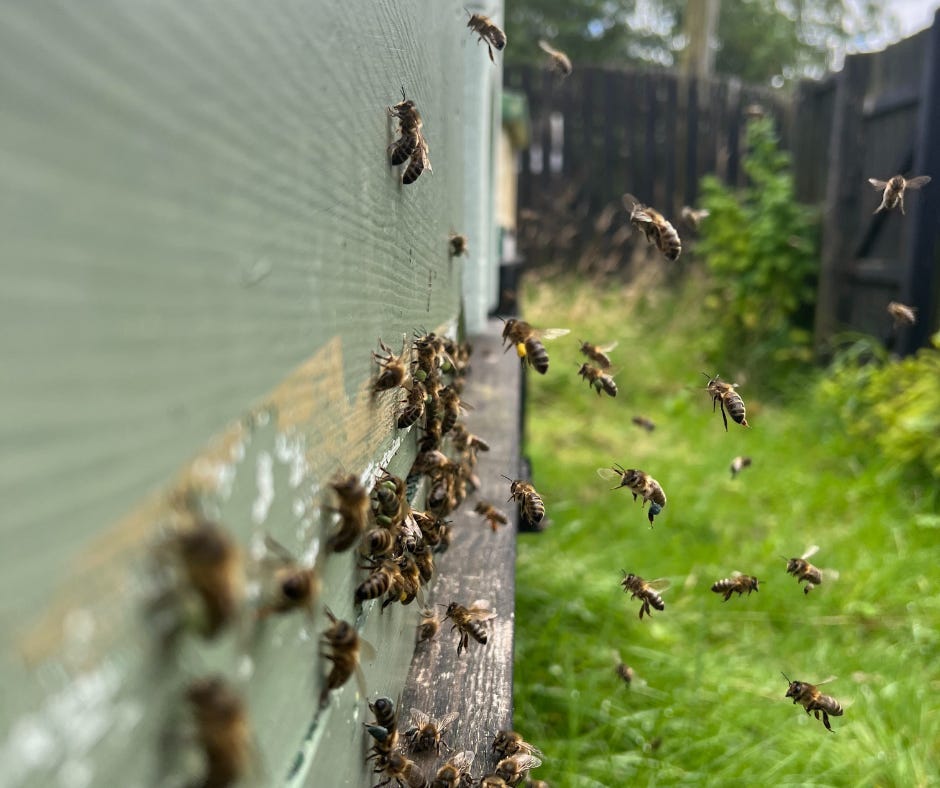
I am not going to lie, the hives had quietened down by about 6.30pm, but that is pretty normal for that time of day. Some foragers were still out, though.
We decided to head up to the hill and, on the way, I spotted some of my bees down in the bog, drinking water from the mud. That was just before the eclipse.
As I mentioned earlier, the clouds were too thick for us to see it, but we were walking through a meadow while it was happening and the light became this really strange, almost twilight-like light. What surprised me was that I did not notice any obvious drop in foraging activity. The bumblebees and honey bees were still out on the fireweed. And on the way back, well past 9pm, I spotted honey bees still foraging on the fireweed.
So whatever was happening above the clouds, the bees I was watching did not seem particularly impressed.
So, did anything know it was coming
Here is where I land and it is a more interesting place than where I started.
There is a real, published, peer-reviewed study showing something in a small stand of spruce trees synchronising well ahead of an eclipse, for reasons science has not yet agreed on. That is genuinely remarkable and genuinely early-stage and worth watching closely as other researchers try to replicate or explain it.
There is no honey bee study, anywhere, showing anything comparable. Every documented bee response, across every eclipse studied, tracks a real, present-tense environmental change, mostly light, occasionally temperature. Nothing in a bee’s known sensory toolkit gives it advance warning of the moon’s position and nothing in the data suggests it needs one.
Which means my opening line was half right for reasons I did not expect and half wrong for reasons I am glad to have checked. The trees, it turns out, might genuinely have known something. My bees almost certainly did not. And I no longer think that makes them the less remarkable of the two. A honey bee’s navigation system is built to keep extracting information from the sky, continuously and with extraordinary precision, without needing to know what comes next. It does not anticipate the future. It simply never stops paying attention to the present.
What we actually know and what we do not
Established: Three spruce trees in the Dolomites displayed bioelectrical synchrony at least fourteen hours prior to a partial solar eclipse in 2022, reported in a scientific publication. How this works remains a scientific mystery.
Established: Honey bees’ flying behaviour follows environmental changes occurring in real time (especially light changes) during an eclipse. They continue their flights during the partial phase and stop almost completely during total eclipse.
Established: bees navigate using polarised light combined with a circadian-corrected sun compass, not the sun’s raw position alone.
Likely, not directly measured: a deep partial eclipse like last night’s produced too little change in illumination to meaningfully disrupt bee flight activity, especially arriving on top of an already-declining evening light curve.
Unknown: What goes on in a beehive during an eclipse. There have been no studies done that have put any sensors inside the hive during an eclipse. All the bee studies done until now have observed either the entrance to the hive or the flower patches.
Unknown: whether nectar production or floral opening changes during an eclipse. I looked. Nobody has published this.
No evidence found and likely false: that honey bees anticipate an eclipse before the environment itself changes.
This is the sort of thing I get distracted by. Frequently. If you would like to receive the next rabbit hole when I fall into it, you can subscribe to Bees & Beyond below. And if you were watching the eclipse with bees nearby, I would genuinely love to know what you saw. There is still a lot we have never measured.
Furter reading & Studies:
Chiolerio, A., Gagliano, M., Pilia, S., Pilia, P., Vitiello, G., Dehshibi, M. & Adamatzky, A. (2025). "Bioelectrical synchronization of Picea abies during a solar eclipse." Royal Society Open Science, 12(4), 241786. https://doi.org/10.1098/rsos.241786
Vacchiano, G. (2026). "Coherence without cause? On the quantum coherence hypothesis in tree electrophysiology during solar eclipses. A Comment on: 'Bioelectrical synchronization of Picea abies during a solar eclipse'." Royal Society Open Science, 13(3), 251239. https://doi.org/10.1098/rsos.251239
Galen, C., Miller, Z., Lynn, A., Axe, M., Holden, S., Storks, L., Ramirez, E., Asante, E., Heise, D., Kephart, S. & Kephart, J. (2018). "Pollination on the Dark Side: Acoustic Monitoring Reveals Impacts of a Total Solar Eclipse on Flight Behavior and Activity Schedule of Foraging Bees." Annals of the Entomological Society of America, 112(1), 20–26. https://doi.org/10.1093/aesa/say035
Waiker, P., Baral, S., Kennedy, A., Bhatia, S., Rueppell, A., Le, K., Amiri, E., Tsuruda, J. & Rueppell, O. (2019). "Foraging and homing behavior of honey bees (Apis mellifera) during a total solar eclipse." The Science of Nature, 106, 4. https://doi.org/10.1007/s00114-018-1597-2
Hains, B. C. & Gamper, H. (2017). "Disruption in honey bee (Apis mellifera) foraging flight activity during a partial solar eclipse shown by individual flight path tracking." Bulletin of Insectology, 70(2), 315–320. https://archive.bulletinofinsectology.org/pdfarticles/vol70-2017-315-320hains.pdf
I fucking LOVE this. I grew up being taught that all living things have life and community, and while we were not able to understand the language that didn't mean they were not entitled to respect and care.
The Light Eaters is an awesome book. It discusses evidence that trees have memory and they make decisions in response to changes in their environment. Scientists bend over backwards to not use terms like intelligence but it is clearly there. Invoking coherent quantum states is definitely in the bending over backwards category. A much simpler explanation is the trees remembered and were able to predict the eclipse.