She Was Declared Extinct in Britain. Scientists Flew to Sweden to Bring Her Back.
The reintroduction of Bombus subterraneus is one of the more remarkable stories in recent British ecology. It is also a warning about what the countryside has become.

The Release
In the summer of 2012, a team of conservation scientists released a group of bumblebee queens into a corner of Kent. The queens had been collected in Sweden. They were representatives of a species that had been declared extinct in Britain for over two decades.
Their name is Bombus subterraneus, the short-haired bumblebee.
The last confirmed sighting of one in Britain had been in 1988. And the reason it had disappeared is both entirely straightforward and, when you understand it properly, quietly devastating.
I write about bees, ecosystems, natural beekeeping, extinction, recovery and the science hidden in ordinary landscapes. Subscribe to join the hive.
A Bee With Requirements
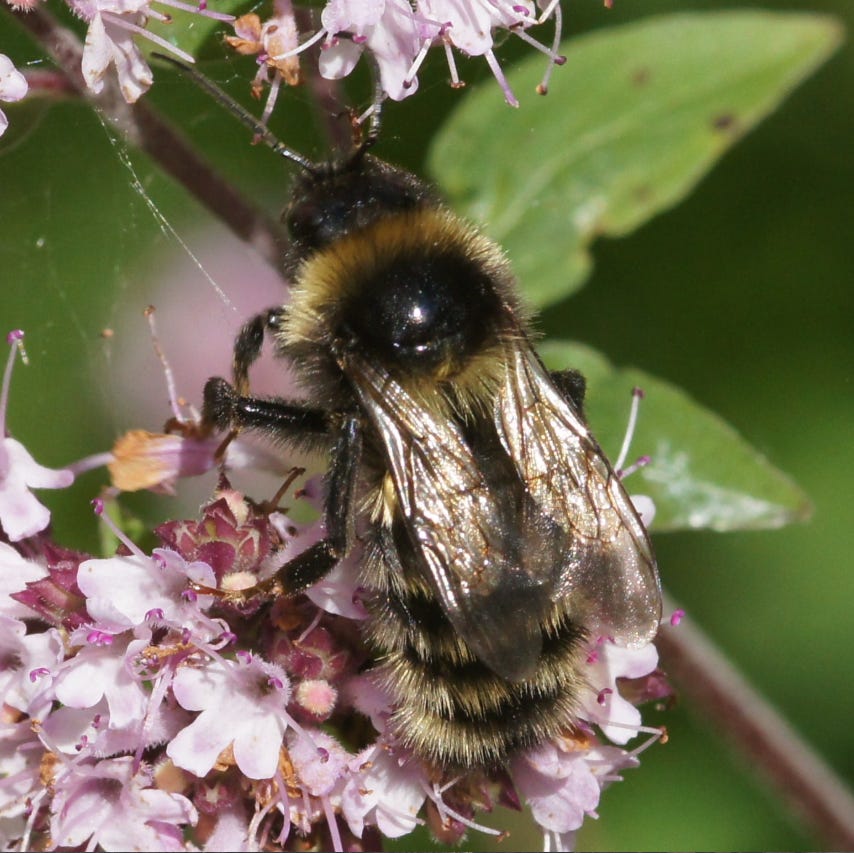
Bombus subterraneus is a long-tongued bumblebee and this is not a trivial detail. Tongue length in bees is an ecological specialisation linked to the shape and depth of the flowers they feed from. Long-tongued species can access the nectar and pollen of deep tubular flowers that shorter-tongued species struggle to reach: red clover, knapweed, bird’s-foot trefoil, vetch.
These plants and the bees that pollinate them have, in many cases, shaped each other across evolutionary time. Remove the flower and the bee goes hungry. Many of these plants also rely heavily on long-tongued pollinators for effective reproduction. The relationship is functional, not decorative and it is very old.
For most of the nineteenth and early twentieth century, this was not a problem. Britain’s lowland countryside was threaded with flower-rich meadows: hay meadows, permanent pasture, and the margins of arable fields managed in ways that accumulated botanical diversity over generations. The short-haired bumblebee had a landscape full of precisely the flowers it had evolved to use.
Then, in the decades following the Second World War, British agriculture industrialised at a pace with no ecological precedent. Wildflower meadows were ploughed, drained, or converted to improved grassland managed for silage. By widely cited estimates, Britain lost approximately 97% of its wildflower meadows between the 1930s and the end of the twentieth century.
The landscape stayed green. It just stopped being alive in the way that mattered.
Most people see a field and think “nature”. Bees often tell a very different story. Subscribe for more ecology, bee science and observational beekeeping articles.

The Silence in the Grass
This is the part worth sitting with. The countryside did not necessarily look damaged. From a distance, from a car window, from the perspective of most people making decisions about land use, it was still green. Green fields, green verges, green hillsides.
But a silage field is ecologically nearly silent. Cut multiple times a year before most plants can flower, it supports very little pollinator diversity. It is, in the language some ecologists use, a green desert.
For a bee with highly specific flower requirements, a green desert is not a near miss. It is a terminal condition.
By the late 1980s, the short-haired bumblebee had effectively run out of habitat. The last one recorded in Britain was seen in 1988. Nobody at the time knew it was the last.
The Swedish Connection
What makes this story unusual is what came next.
Bombus subterraneus was extinct in Britain, but it was not globally extinct. Viable populations still existed in parts of Scandinavia and, historically introduced for agricultural pollination, in New Zealand.
On the Swedish island of Öland, the species persisted in flower-rich grasslands that had survived agricultural intensification far better than comparable habitats in Britain.
The reintroduction project, involving Natural England, the Bumblebee Conservation Trust, the RSPB, and others, began with a clear understanding that bringing queens back was only half of the work. The other half, arguably the harder half, was preparing somewhere for them to live.
Before a single bee was released, habitat restoration was carried out across the Dungeness and Walland Marsh area in Kent. Farmers and landowners worked to re-establish flower-rich grassland. The infrastructure of a functioning ecosystem had to be rebuilt before the species could return to use it.
From 2012 onwards, queens collected in Sweden were released at restored sites in Kent. Over the following years, the species was recorded breeding successfully. The project is considered cautiously promising, although the population remains small and carefully monitored.
If you want more strange, overlooked and scientifically fascinating bee stories in your inbox, you can subscribe below. 🐝
What Recovery Actually Looks Like
The short-haired bumblebee is not fully recovered. It is rare, closely monitored and still dependent on the continued management of a relatively small number of restored habitats.
Its return is not a triumph to celebrate and move on from. It is a careful beginning that requires long-term commitment to remain a beginning at all.
What this story demonstrates, more than anything else, is that extinction is often a symptom rather than a singular event. The short-haired bumblebees did not simply fail. The landscape failed to remain a place where they could survive.
Reintroduction without habitat restoration is mostly an exercise in futility. You are returning an animal to the same conditions that removed it in the first place.
The genuinely hopeful part of this story is that habitat can return. Flower-rich meadows can be restored. Long-tongued bumblebees respond to the return of their required plants with a reliability shaped by deep evolutionary relationships. When the flowers come back, the bees notice.
The short-haired bumblebee is flying in Kent today because people decided the habitat was worth restoring before the species was worth rescuing.
That sequence, habitat first, species second, may be the most important lesson in the entire story.
From extinct bumblebees to the hidden architecture of the hive, Bees & Beyond explores the science and stories most people never hear about pollinators. Subscribe below if that sounds like your kind of thing.
Further Reading
Bumblebee Conservation Trust: Short-haired bumblebee project
https://www.bumblebeeconservation.org/publications/the-short-haired-bumblebee-reintroduction-project-10-year-report/
Disease risk analysis for the reintroduction of the short-haired bumblebee (Bombus subterraneus) to the UK (NECR216)
https://discovery.ucl.ac.uk/id/eprint/1522569/
Plantlife: State of UK Meadows
https://www.plantlife.org.uk/our-work/state-of-nature-2023-plants-and-fungi/
Goulson et al. (2008), Annual Review of Entomology
https://www.annualreviews.org/doi/10.1146/annurev.ento.53.103106.093454
Interesting. The land and the beings are both in need of variety, and the movement acts as the enabler.
We need more restoration, not degradation.